
For a while, Azure VMware Solution felt like one of the safer places to hide from Broadcom.
You could move your VMware workloads into Azure, keep vSphere and the tools your team already knows, and let Microsoft deal with most of the platform underneath it. Better yet, the VMware licensing was baked into the service. It was a nice arrangement.
Naturally, we couldn't have nice things forever.
Broadcom has now extended its new VMware Cloud Foundation licensing model into the hyperscaler world, including Azure VMware Solution. If your first thought is, “Wait, I moved VMware to Microsoft Azure, and I still have to deal with Broadcom licensing?” then yes. I am sorry.
I don't make the rules. If I did, enterprise software licensing would fit on one page, printer drivers would work on the first try, and every meeting invitation would require a written explanation of why it couldn't have been an email.
So, What Actually Changed?
As of November 1, 2025, Microsoft stopped including a VMware Cloud Foundation subscription with new AVS node purchases. New AVS deployments now require portable VCF licenses purchased from Broadcom.
Existing customers got some breathing room, but that breathing room has an expiration date. Microsoft has announced that AVS license-included SKUs will retire on August 30, 2027.
If you are running license-included AVS through reserved instances, you can continue using those entitlements until the reservation expires or August 30, 2027, whichever comes first. If you are using older license-included AVS nodes on pay-as-you-go pricing, the deadline comes much sooner. Those environments need to transition to portable VCF licensing by October 31, 2026.
After that, staying on AVS means bringing your own Broadcom VCF subscription.
There are a few other wrinkles because, apparently, the licensing flowchart did not have enough arrows yet. Certain VMware vDefend Firewall use cases can also require separate Broadcom add-on licensing.
None of this means Azure VMware Solution itself is going away. AVS remains a supported Microsoft service. You can keep running VMware on Azure.
You just got the exciting new opportunity to maintain a Microsoft Azure commercial relationship and a Broadcom VMware licensing relationship at the same time.
It's the enterprise IT equivalent of getting divorced but keeping the joint Costco membership.
AVS Did Its Job
I want to be clear here: AVS is a good product.
For many companies, it was exactly the right answer. If you had a few hundred VMware virtual machines sitting on aging hardware and somebody told you the data center lease ended in nine months, AVS gave you a way out without rebuilding every application on the way.
You could move first and modernize later. That is a sound migration strategy.
The problem is the word later.
Later has a nasty habit of becoming three years from now. The applications work. Nobody is complaining. The migration project closes. Everyone goes home. Then one morning, somebody looks at the Azure bill, the VMware licensing model, and the renewal calendar and asks a dangerous question:
“Why are we still running VMware?”
And suddenly, everyone becomes very interested in the modernization roadmap that has been sitting untouched in SharePoint since 2023.
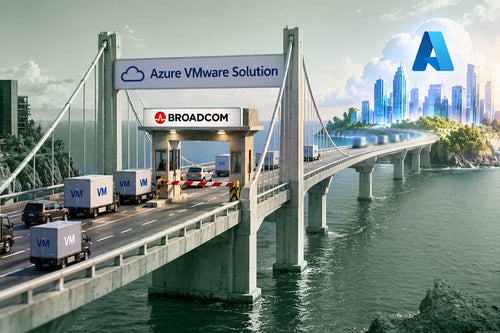
AVS Was a Bridge
I have always viewed AVS as a bridge into Azure rather than the end of the journey for most customers.
That bridge made sense because moving VMware workloads into AVS removed a huge amount of migration risk. Once those applications are already in Azure, though, the question changes.
You are no longer asking how to get out of your data center without breaking everything. You are asking whether each workload still needs VMware at all.
For a surprising number of VMs, the answer is no.
A Windows application server may work fine as an Azure VM. A SQL Server may be a good fit for Azure SQL Managed Instance. A web application may move to Azure App Service. File services may belong on Azure Files. Remote desktop workloads may make more sense on Azure Virtual Desktop.
Some applications can be modernized. Some should stay exactly as they are. And some server that everyone is afraid to turn off turns out to have been running an application last used by Carol in Accounting in 2017.
Carol retired.
The server did not.
This is why we assess things before migrating them.

Azure Native Does Not Mean “Rewrite Everything”
The phrase “Azure Native” can scare people because it sounds like somebody is about to propose rebuilding your entire business as Kubernetes microservices.
Please don't.
I like containers as much as the next infrastructure guy, which means I like them exactly as much as necessary and no more.
Moving from AVS to Azure Native does not require rebuilding every application. In many cases, the simplest path is moving a VM from AVS to an Azure VM and calling it a successful Tuesday.
Microsoft Azure Migrate supports both agentless and agent-based migration from Azure VMware Solution into Azure. It can discover workloads, collect performance data, map dependencies, assess sizing, and help build migration waves.
That gives us options. Some workloads get rehosted. Some get right-sized. Some get replatformed. Some get retired. And some stay on VMware because there is a real technical reason for them to remain there.
The important part is that VMware stops being the default answer just because VMware is where the workload lives today.
The Economics Have Changed
Broadcom's licensing changes make that conversation much more important.
Previously, an AVS customer could look at the Azure bill and get a good idea of what the VMware platform cost. Going forward, customers moving to the BYOL model need to consider both the Azure infrastructure cost and their Broadcom VCF subscription.
That changes the math.
AVS also runs on dedicated hosts. That model is part of what makes the service predictable and compatible with VMware, but it means you are buying capacity at the host level.
Azure Native gives us more room to right-size workloads individually. A VM using two CPUs and 12 GB of memory does not necessarily need to live inside a large dedicated VMware host forever just because that is where it started.
Multiply that across dozens or hundreds of workloads, and the difference can become meaningful.
Now that Broadcom licensing sits beside the infrastructure cost instead of being neatly bundled into the AVS service price, this is a very good time to sharpen the pencil.
Preferably not the same pencil Broadcom has been using to write VMware quotes.

Microsoft May Help Pay for the Migration
This is also where the timing becomes interesting.
TrustedTech can work with eligible customers to pursue Microsoft investment programs, including opportunities such as the Azure Frontier Offer and End Customer Investment Funds, depending on the customer, workload, projected Azure consumption, program availability, and Microsoft approval.
Those funds can help offset the professional services cost of planning and completing the move from VMware to Azure Native services. For some qualified projects, Microsoft funding can reduce a large portion of the migration cost. In certain cases, it can cover the migration work itself.
Eligible opportunities may also receive Azure consumption incentives worth up to 20% of the first-year qualifying Azure Native consumption.
There are rules, eligibility requirements, approval processes, and funding limits.
Of course there are.
This is enterprise technology. Somewhere, there must be a spreadsheet.
But if you are already considering leaving AVS, doing the work while Microsoft has financial incentives aimed at moving VMware workloads onto Azure Native infrastructure makes a lot more sense than waiting until a Broadcom renewal forces the conversation.
Start With the VMware Migration Readiness Assessment
Before we migrate anything, we need to answer a much simpler question: what exactly are we dealing with?
TrustedTech's VMware Migration Readiness Assessment is designed to answer that. We review the current AVS environment and build a detailed picture of what is running, how it is being used, what depends on what, and where each workload should go.
That includes compute utilization, memory, storage, operating systems, networking, application dependencies, SQL workloads, backup requirements, disaster recovery, identity, security, and current Azure costs.
Azure Migrate can collect much of this information from the existing AVS environment, including performance data and application dependencies. Then we add the part that tools are not very good at: context.
Just because a VM can move somewhere does not mean it should.
An assessment needs engineers who can look at a workload and decide whether it belongs on an Azure VM, Azure SQL, App Service, Azure Virtual Desktop, Azure Files, another service, or exactly where it is today.
The result is not a 70-page PDF that spends six pages explaining what “cloud” means. You get a migration plan that shows what moves, where it moves, how it moves, what it costs, what needs remediation, what depends on what, and what order the work should happen in.
It also tells us what we should probably shut off instead of paying to move.
Better still, the assessment cost is credited back when TrustedTech performs the migration work, making the VMware Migration Readiness Assessment free as part of the larger migration engagement.

Get Your VMware Migration Readiness Assessment
Find out exactly what's running in your AVS environment, what it depends on, and where each workload should go, before Broadcom's licensing deadlines force the decision for you.
Start Your AssessmentYou Don't Have to Move Everything at Once
One of the biggest advantages of starting before Broadcom sends a licensing deadline crashing through your front door is that we can do this in phases.
A normal project might begin with a small group of simple workloads. We move them, test the process, and validate networking, identity, security, backup, monitoring, and application performance. Then we move to the next group.
More complex applications come later, after the migration pattern has been proven.
That approach is far less exciting than announcing a heroic three-day migration weekend involving 400 servers, six engineers, 37 pizzas, and one person quietly updating their résumé at 3:14 Sunday morning.
I am perfectly comfortable with less exciting.
Less exciting is good infrastructure.
There Is Still Time. That's the Point.
If you have AVS reserved instances that still carry license-included VCF, August 30, 2027, may sound far away.
It isn't.
Large migration projects have a remarkable ability to consume calendars. Discovery takes time. Dependencies need to be understood. Landing zones need to be validated. Applications need testing. Business owners need to sign off. Maintenance windows need to be scheduled.
And somebody will discover a server running Windows Server 2012 that “can't have downtime.”
There is always one.
The goal is not to panic and evacuate AVS tomorrow. The goal is to use the time you have while you still control the schedule.
Assess the environment. Understand what your next Broadcom licensing step looks like. Compare AVS plus VCF against Azure Native. Identify available Microsoft funding. Build a migration plan. Then make the decision based on actual numbers.
AVS was a great way to move VMware into Azure without changing everything at once, and for many customers, it has done exactly what it was supposed to do.
But a bridge is most useful when you eventually reach the other side.
And with Broadcom now standing at the toll booth holding a new rate card, this might be a pretty good time to keep driving.
Sources
Microsoft's current AVS guidance confirms that Broadcom's November 2025 hyperscaler licensing change requires customers to bring portable VCF licensing, that Microsoft is retiring the license-included AVS SKU on August 30, 2027, and that AVS itself is not being retired.
Microsoft Learn: AVS license-included service retirement and VCF BYOL options
Microsoft's updated portable VCF reference provides the detailed deadlines: November 1, 2025, for new deployments, October 31, 2026, for older license-included PAYG deployments, and August 30, 2027, for license-included reserved instances. It also documents the separate vDefend licensing requirements and customer compliance responsibilities.
Microsoft Learn: Portable VCF licensing reference for Azure VMware Solution
Microsoft's configuration documentation explains how existing AVS environments can move to portable VCF licensing, including exchanging license-included reservations for BYOL reservations and registering Broadcom entitlement information in Azure.
Microsoft Learn: Configure portable VMware Cloud Foundation for AVS
Broadcom describes its side of the licensing change as a move to a “license portability-only” hyperscaler model, under which customers buy VCF subscriptions from Broadcom and use those entitlements on supported hyperscalers.
Broadcom VMware Cloud Foundation: Cloud on Your Terms
Microsoft documents that Azure Migrate can discover workloads directly from AVS, collect performance and dependency information, and assess them for Azure migration.
Microsoft Learn: Discover VMware and AVS workloads with Azure Migrate
Microsoft Learn: VMware-to-Azure migration guidance
Microsoft's current support matrix also confirms that both agentless and agent-based migration from AVS to Azure VMs are supported.
Microsoft Learn: Azure Migrate VMware migration support matrix