
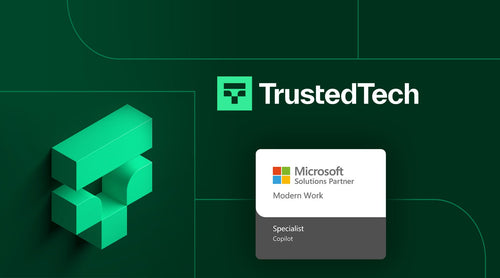
TrustedTech achieves Microsoft’s Copilot Specialization, validating its hands-on delivery capability across Microsoft 365 Copilot, Copilot Chat, Copilot Studio, and agentic AI implementations.
Irvine, CA, June 23, 2026 — TrustedTech, a certified Microsoft Cloud Solution Provider (CSP) serving more than 6,000 cloud customers globally, has earned the Microsoft Copilot Specialization under the Microsoft AI Cloud Partner Program. The credential validates TrustedTech’s verified delivery capability across the full Copilot stack: Microsoft 365 Copilot, Copilot Chat, Copilot Studio, and agent implementations.
The specialization launched in July 2025 to address a straightforward problem: tens of thousands of Microsoft partners claim Copilot expertise, but very few have the deployment track record and certified staff to support that claim. Earning it requires clearing a performance bar, fielding certified technical staff across multiple disciplines, and submitting verified customer references that include at least one production agent implementation. TrustedTech has met all three.
What the Microsoft Copilot Specialization Requires
Before a partner can apply, they need an active Solutions Partner designation in Modern Work, Business Applications, or Security. That prerequisite alone removes most of the market from consideration.
From there, Microsoft evaluates three categories of evidence.
Performance: The partner must demonstrate 1,000 monthly active user (MAU) growth in Microsoft 365 Copilot over the trailing 12 months, plus five net new Copilot customers in the same period. These are measured through verifiable association types: Claiming Partner of Record (CPOR), CSP Tier 1, and CSP Tier 2. Self-reported numbers are not accepted.
Skilling: Fifteen certified staff members across three disciplines. Five hold MS-102: Microsoft 365 Certified Enterprise Administrator Expert. Five hold either SC-401 (information protection and security in M365) or APL-4002 (security and compliance readiness for Copilot). Five hold APL-7008: Create Custom Agents with Microsoft Copilot Studio. The weight Microsoft put on security certifications here is deliberate: responsible Copilot deployment starts with a properly governed tenant, not with feature activation.
Customer references: Three verified deployments, at least one of which demonstrates real business process transformation through agent implementation. Production deployments with documented outcomes, not demos or pilots.
TrustedTech met all requirements. The specialization renews annually, so the credential reflects the state of TrustedTech’s practice today, not when it was first earned.
What This Means When Choosing a Copilot Partner
The credential gives organizations a practical filter. It answers whether a partner has shipped Copilot at scale with verified outcomes, not whether they have a Copilot slide deck.
In practice, most Copilot deployments hit the same friction points before a single license is assigned. SharePoint permissions are too broad. Sensitivity labels are missing or inconsistently applied. Nobody has made a deliberate decision about what Copilot can and cannot surface. These aren’t unusual situations; they’re the norm. A partner without a strong security foundation can get you to “Copilot is turned on.” A partner with verified capability in governance and compliance can get you to “Copilot is working, and working safely.”
The structure of the Copilot Specialization requirements follows that same logic. The SC-401 and APL-4002 certifications cover information protection and compliance posture first. The APL-7008 covers custom agent development once the environment is ready for it. That sequence isn’t arbitrary.

Why Timing Matters: Copilot Is Getting More Autonomous
Copilot Cowork reached general availability in June 2026. Unlike earlier Copilot features, Cowork handles complex, multi-step tasks in the background, taking real actions across your data while operating inside Microsoft 365’s governance and compliance controls. Critique and Council launched alongside it. Agentic Outlook is now actively triaging email and resolving calendar conflicts without a user initiating the request.
Earlier Copilot features waited for a prompt. These don’t. The governance surface area grows with each of these releases, and the difference between a partner who passed Microsoft’s verified requirements and one who didn’t becomes more consequential as that surface grows.
TrustedTech’s Copilot Specialization covers this territory by design. The skilling requirements include agent development and security posture as explicit criteria. The customer references require production outcomes, not presentations. For customers deploying Microsoft 365 Copilot now and planning for broader agentic capabilities, those requirements are the right ones to look for in a partner.
Where This Credential Fits in the Partner Hierarchy
TrustedTech holds Solutions Partner designations across Modern Work, Security, Business Applications, Data and AI (Azure), Infrastructure (Azure), and Digital and App Innovation (Azure). The Copilot Specialization adds to that foundation and reflects what TrustedTech’s practice focuses on today: helping organizations get real, measurable value from Microsoft 365 Copilot in a secure, governed environment.
For organizations thinking through what Microsoft’s Frontier Transformation initiative means for their AI strategy, that background is worth reading before committing to a deployment path.
Frequently Asked Questions
Q. What is the Microsoft Copilot Specialization?
A. A credential in the Microsoft AI Cloud Partner Program that validates a partner’s verified delivery capability across Microsoft 365 Copilot, Copilot Chat, Copilot Studio, and agentic implementations. Microsoft reviews it annually, so it reflects current capability rather than a one-time audit.
Q. How does the Copilot Specialization differ from a Solutions Partner designation?
A. A Solutions Partner designation confirms broad capability across a solution area. The Copilot Specialization requires one as a prerequisite, then adds verified performance metrics, 15 certified staff across security and agent development disciplines, and documented production customer outcomes. It is a harder, narrower credential.
Q. Why do the skilling requirements include security certifications?
A. Copilot’s output depends entirely on the quality of the data and permissions it operates on. Microsoft included the SC-401 and APL-4002 certifications to confirm that specialized partners understand information protection and compliance readiness before they start building agents or rolling out licenses.
Q. How long is the specialization valid?
A. One year. Partners must meet the requirements again at renewal. That annual review is what makes the badge a current indicator rather than a historical one.
Q. Does the specialization cover Copilot Cowork and agentic features?
A. The specialization covers the full Copilot stack including Copilot Studio and agent implementations. As features like Cowork expand what agents can do autonomously, the requirement for verified agent implementation references carries more weight, not less.
Q. How can you verify a partner holds the Copilot Specialization?
A. Check the partner’s profile in the Microsoft Solutions Partner directory through Partner Center. The specialization appears there with a renewal date. If a partner claims the credential but it isn’t listed in Partner Center, ask them to show it.
What’s Next
TrustedTech keeps investing in the certifications and technical depth that help customers move quickly with Microsoft technology. The Copilot Specialization reflects where the practice stands today; staying current means continuously meeting the requirements.
If your organization is planning a Microsoft 365 Copilot deployment or thinking through agentic capabilities, start with TrustedTech’s Copilot Readiness Assessment. It gives your team a clear picture of where your environment stands before licenses are assigned and agents are enabled. For organizations on Microsoft 365 E5 evaluating the M365 E7 Frontier Suite, that context is useful to have before the next renewal conversation.

Microsoft 365 Cost Optimization
How to Reduce Microsoft 365 Costs by 20% or More
The Complete Playbook for Reducing M365 Spend. Everything IT leaders and procurement teams need to cut Microsoft 365 costs without cutting capability.
- License right-sizing strategies
- SKU comparison and downgrades
- CSP vs. direct pricing analysis
- Governance and audit frameworks
- Copilot and add-on cost controls
- Renewal negotiation tactics
Find Hidden Waste in Your Microsoft 365 Stack
What kind of M365 admin are you? Uncover ways to reduce costs, simplify management, and improve security.