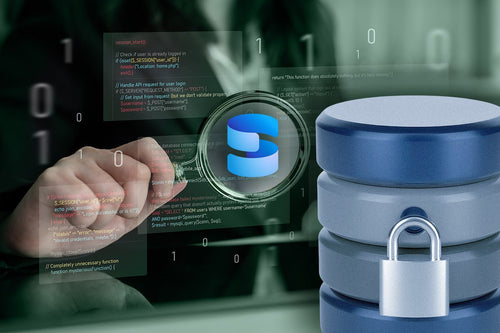
Security is paramount as SQL Server becomes more powerful with AI and cloud integration. SQL Server 2025 brings zero trust principles and granular security controls to ensure these new capabilities don’t come at the cost of data breaches or compliance issues.
Key security enhancements include:
Microsoft Entra (Azure AD) Managed Identities
SQL Server 2025 can use Azure AD managed identities to authenticate Azure services and resources. This means instead of storing usernames and passwords or access keys for things like blob storage, Event Hubs, or external model endpoints, the SQL Server instance can have an identity that’s trusted - no more embedding secrets in connection strings, a huge win for security. For example, suppose SQL needs to call an Azure OpenAI model or write to a storage account. In that case, it can do so under its managed identity, eliminating hard-coded credentials in your code or config.
Zero Trust Architecture
Building on the above, 2025 ensures that every access request is fully authenticated, authorized, and encrypted. Azure AD authentication for users was introduced earlier; it’s now the default recommendation, and features like TLS 1.3 encryption are enabled by default for connections. Role-based access control is extended to new features (like external models). The idea is that even within your network, the database treats each connection with rigorous verification, assumes a breach, and limits what each component can do. In practice, this aligns with features such as always-encrypted data, multi-factor authentication for admins via Entra ID, and the mentioned managed identity usage. It also includes improved auditing and monitoring of AI activities. For instance, if someone tries to call an external model that they don’t have rights to, it will be logged and blocked.
Role-Based Access for AI and Data
SQL Server 2025 has expanded role definitions and permissions to cover the AI integrations. There are controls over who can create or execute EXTERNAL MODEL objects and who can use features like change data streaming. Granular identity and auditing are in place whenever a model is invoked. For example, DBAs can require only certain roles to run a vector similarity search on sensitive vectors, or only the data science team can call a particular external model that returns personally identifiable information. Each call to an external model can be audited with the user context. This level of control is essential when deploying AI inside a database, to prevent abuse or leaks; it’s analogous to permissions on stored procedures.
Stronger Encryption and Hashing
On the more behind-the-scenes front, SQL 2025 upgrades cryptography defaults. It moves to AES-256 (with OAEP padding) for encryption and uses SHA-2/PBKDF2 with 100,000 iterations for password hashing. In non-technical terms, any data encrypted by SQL (like backups, Transparent Data Encryption, etc.) uses more modern, secure algorithms by default, and stored passwords (like SQL logins) are hashed in a way that is far harder to crack. These changes align SQL Server with the latest security standards (NIST guidelines) and protect against brute-force attacks.
Continued Ledger and Data Integrity
SQL Server 2022 introduced Ledger (blockchain-like tamper-evident tables). SQL 2025 continues to improve on this, making it more practical (with features like granular cache invalidation for ledger so that permission changes don’t require massive overhead). This ensures that if you use SQL for scenarios where data integrity is critical (finance, auditing, etc.), the AI features do not compromise that, and you can have tamper-evident, verifiable records alongside your new AI-driven data columns.

Why It Matters
Adding AI and cloud connectivity could raise new security concerns. Microsoft anticipated this and built SQL Server 2025 to increase security in tandem with functionality. Managed identities mean fewer secrets that hackers or even insiders can steal. Role-based controls mean that if an AI feature is misused (say someone tries to pull a lot of data via an external model call), you have oversight and the ability to restrict it. The zero trust approach is critical in a world of hybrid cloud and frequent cyber threats: it reduces the attack surface by ensuring every call, integration, or user action is verified and using least privilege. This means organizations can adopt SQL 2025’s flashy AI features without loosening their security posture; in fact, they will likely be tightening it. The stronger encryption and hashing are mostly invisible to end-users but provide peace of mind that the database is secure by design (compliance officers will love knowing password hashes are using 100k iterations now, for example).
Additionally with the data being piped to the models or out to the services you need to be ensuring that you’ve got encryption in transit (TLS 1.3) and proper authentication to avoid man in the middle attacks and data leakage. The zero trust focus also means you’re going to have better monitoring. Anomalies in data access, or odd Copilot queries for instance, can be picked up by systems such as Defender for Cloud or Sentinel which can be set up to monitor the SQL Server logs.
Use Cases
Your database needs to call an Azure Function to get the exchange rates for a currency conversion. In SQL 2022 you might have had the API key stored in a table or in the code. In 2025 you’d be using a managed identity (the SQL Server would log into Azure AD and that would grant it the permission to call that function) and no secrets would be anywhere. If someone got read access to your database they wouldn’t be able to find any credentials to abuse. Another use case is controlling the use of an AI model. A hospital might have an external model that they use to summarize patient notes. With RBAC you could have the model only available to doctors (i.e. only people in a particular DB role) and all the queries would be logged with the ID of the user. If an intern (who wasn’t in that role) tried to run it, the database would simply deny it.
Another example is data exfiltration protection: an AI model could potentially be abused to smuggle data out (since it might send data to an API). But because in SQL 2025 you could say “only allow model X to be called, and only return aggregated results,” you reduce that risk. The DB can also limit how much data any single model call can process. Row-level security can do this, as can withholding direct table access from the user and granting it only to the model, which then does limited processing. Either way, AI actions are effectively sandboxed.

Shop SQL Server Licensing: Standard & Enterprise
Browse SQL Server Standard and Enterprise licensing options and find the right fit for your environment’s core count and workload.
Shop SQL Server LicensingImproved Encryption
The improved encryption is also functional: if your backups are stolen but were taken with SQL 2025’s default encryption, they’re safer than if encrypted with older algorithms. And for password security, if someone got hold of your SQL login hashes, the PBKDF2 100k iteration means it’s exponentially harder to crack than the older SHA1 or unsalted hashes from ages past.
Finally, Zero Trust means even internal calls, like a replication between two servers or a connection from an app server on the same network, are not trusted implicitly; everything needs proper tokens or certificates. This can prevent insider threats or malware that gets into one server from easily hopping into the database. Microsoft is integrating SQL Server tightly with Azure Arc; you can also uniformly manage security policies across on-premises and cloud-deployed SQL from Azure, ensuring nothing is overlooked.
Trust Nothing, Secure Everything
- Managed Identity Authentication: SQL Server can use Azure AD identities instead of passwords to connect to services, removing risky embedded credentials.
- Enhanced Crypto & RBAC: Default encryption and hashing algorithms are tougher, and every new AI feature obeys role-based permissions with full auditing.
Related SQL Server 2025 Articles