

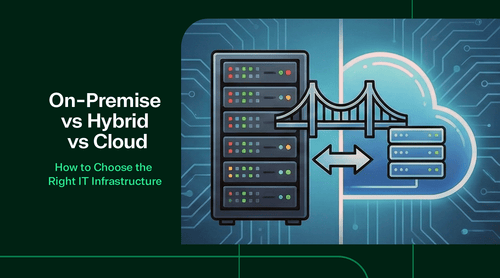
Selecting the appropriate IT infrastructure: cloud, on-premises, or hybrid, is a critical decision for IT leaders. Each model affects costs, security, compliance, and scalability in distinct ways. This guide analyzes strengths, trade-offs, and decision criteria to help organizations align technology choices with business objectives.
Key Takeaways
- Cloud provides elastic, pay-as-you-go scaling. On-premises offers maximum control but requires significant upfront investment. Hybrid integrates both approaches to optimize workload placement.
- Cloud cost management requires active governance to prevent resource waste, while on-premises solutions offer more predictable hardware and facility expenditures.
- Cloud operates under a shared responsibility model: providers secure the infrastructure, while customers configure protections. On-premises grants internal teams full security control (and responsibility).
- SMBs often choose cloud for agility. Regulated industries frequently select on-premises or hybrid for compliance control. Growing organizations benefit from hybrid’s phased scalability.
- Key risks include vendor lock-in, unanticipated cloud expenses, security misconfigurations, workforce skill gaps, and hybrid complexity (especially unified identity across environments).
Why This Decision Matters
Selecting the appropriate IT infrastructure has a significant impact on costs, security, compliance, and scalability. This guide helps organizations align technology decisions with business objectives by analyzing the strengths, trade-offs, and key criteria of each model.

Understanding the Core Models
As an IT leader, your choice among cloud, on-premises, or hybrid determines where workloads run, shapes management responsibilities, and sets scalability boundaries. Mastering these foundational options is crucial for evaluating costs, maintaining compliance, and supporting long-term strategy.
Cloud Infrastructure
Cloud infrastructure uses pay-as-you-go compute, storage, and services delivered over the internet. Organizations can provision resources quickly and scale globally without direct hardware management. In Microsoft-aligned environments, cloud solutions integrate with modern development tools. Cloud offers on-demand access to a shared pool of configurable resources, supporting rapid scalability and flexibility.
On-Premises Infrastructure
On-premises infrastructure requires organizations to own and operate servers, networks, and storage. This model provides control over performance, data residency, and physical access. However, it involves significant upfront capital investment and ongoing lifecycle management, including installation, maintenance, and hardware refresh cycles.
Hybrid Infrastructure
Hybrid infrastructure integrates on-premises and cloud services into a unified operating model. Sensitive or latency-critical workloads remain local, while burst, analytics, or seasonal services can run in the cloud. This supports phased modernization and helps align compliance requirements.

Pros and Cons of Each Model
IT leaders must assess the unique advantages and limitations of each infrastructure model to ensure the choice aligns with business objectives and mitigates operational and strategic challenges.
Cloud Advantages & Drawbacks
Advantages
- Elastic scale for spikes, pilots, and global rollouts
- Reduced hardware maintenance; rapid access to new services
- Built-in high availability options and geographic reach
Drawbacks
- Ongoing OpEx and variable bills; requires cost governance
- Provider dependencies (service limits, regional availability, egress)
- Security is shared: misconfigurations remain your responsibility
On-Premises Advantages & Drawbacks
Advantages
- Maximum control over data, performance, and change windows
- Easier alignment with strict data sovereignty or bespoke controls
- Predictable performance once capacity is right-sized
Drawbacks
- High CapEx plus facilities costs (power, cooling, space)
- Scaling requires procurement cycles; hardware refreshes recur
- Requires in-house expertise for security, DR, and capacity planning
Hybrid Advantages & Drawbacks
Advantages
- Place each workload in the best-fit venue for cost, risk, and performance
- Phase legacy modernization without a risky big-bang cutover
- Keep sensitive data on-prem while leveraging cloud innovation
Drawbacks
- Added complexity: identity, networking, policy, and observability must span environments
- Requires integration discipline to avoid tool sprawl and blind spots
- Governance, tagging, and CMDB accuracy become non-negotiable

Cost Considerations
Costs are distributed differently across capital expenses, operating expenses, and licensing depending on the model. A clear view of these dynamics helps build accurate ROI models and prevent budget overruns.
Cloud Cost Factors
Cloud costs are usage-based: compute hours, storage, data transfer, and managed services. Commitments and right-sizing can reduce waste, while FinOps practices improve visibility and governance across teams.
Practical tips
- Tag resources by owner, app, and environment. Implement consistent tagging so each resource is labeled with business owner, application, and environment (production, staging, development).
- Use budgets and alerts per business unit. Set spending thresholds at department or project level and configure alerts at 50%, 75%, and 90% of budget.
- Model license impacts. Use licensing calculators (e.g., SQL Server) to understand how core counts, editions, and benefits affect total cost before migrating database workloads.
On-Premises Cost Factors
On-premises costs include hardware, facilities (power and cooling), warranties, and staffing. Additional considerations include software licenses, client access licenses (CALs), backup systems, and disaster recovery sites. This model offers predictable capacity and fewer variable expenses when usage is consistent.
Hybrid Cost Factors
Hybrid models combine CapEx and OpEx. Core on-premises capacity supports always-on workloads, while cloud resources address burst, analytics, or new service demands. Effective monitoring prevents cloud sprawl and optimizes on-prem utilization.

Security and Compliance Implications
Security and compliance responsibilities shift depending on the model. Understanding how control is divided between the provider and the organization is crucial for protecting sensitive data and meeting regulatory requirements.
Cloud Security
Cloud providers secure the underlying infrastructure; customers configure identity, data, and workload protections. This shared responsibility varies by SaaS, PaaS, and IaaS. Align controls and automation to that split, and audit regularly.
Public baselines (such as government security configuration guidance for Microsoft 365 tenants) can help standardize secure configurations across organizations use them to inform policy and control baselines.
On-Premises Security
On-premises environments provide full control over physical, network, and host security. That control also means full responsibility: patching, EDR, segmentation, backups, and disaster recovery are owned by your team. For regulated sectors, custom controls can be easier to prove when infrastructure is directly managed internally.
Hybrid Security
Hybrid keeps sensitive data or specific workloads on-prem while leveraging the cloud for innovation and burst capacity. The complexity is identity and policy: enforce least privilege across both planes, unify logging, and standardize guardrails so teams can move fast without bypassing controls.

Use Cases by Business Type
Different organizations benefit from different infrastructure approaches. SMBs, regulated enterprises, and organizations in transition face unique constraints that influence whether cloud, on-premises, or hybrid is the best fit.
Small & Mid-Sized Businesses
SMBs often adopt cloud-first to improve agility and reduce operational overhead. Managed services reduce administrative burden, and modern identity/device controls support distributed teams. For remote or field workforces, strengthening unified endpoint management (UEM) and Intune with mobile device management can help ensure consistent policy enforcement.
Enterprises in Regulated Industries
Financial services, healthcare, and public sector workloads often prefer on-premises or hybrid for data residency and control. Hybrid enables selective cloud adoption for analytics and AI while keeping system-of-record data local.
When the stakes are high, TrustedTech’s professional services for environment optimizations can align controls, documentation, and licensing with auditors’ expectations.
Organizations Scaling Gradually
For modernization across multiple quarters, hybrid provides a predictable transition path. Collaboration and analytics can move first, followed by gradual refactoring of line-of-business apps as capacity permits. Microsoft 365 productivity may be enhanced with Microsoft Copilot to support knowledge work during core system transitions.

Risks and Challenges to Watch
Infrastructure decisions can introduce risks ranging from vendor lock-in to cost overruns and security missteps. Identifying these early helps leaders plan defenses and protect long-term outcomes.
- Vendor lock-in: Build with portable patterns where possible (e.g., containers, open standards).
- Unexpected cloud bills: Poor cost visibility and idle resources drive surprise spending; adopt FinOps guardrails early.
- Skill gaps: Upskill teams on identity, IaC, and security baselines with training plus templates and golden images.
- Security misconfigurations: Common risks include IAM weaknesses, misconfigured services, and insecure APIs; use automated checks and policy-as-code.
- Hybrid integration complexity: Plan identity, networking (DNS, routing), and observability from day one to avoid blind spots.
- Compliance drift: Document the shared responsibility split and map controls to auditor-expected frameworks.

Making the Right Decision
The best infrastructure choice directly supports business outcomes. Evaluating workloads, compliance requirements, and financial models creates clarity, while planning for scale ensures the decision holds up over time.
- Align with business goals and budget horizon. Identify what needs improvement (speed to market, risk posture, unit cost). Time-box ROI expectations at 12, 24, and 36 months.
- Classify workloads. Separate steady, latency-sensitive, and bursty jobs and decide where each best fits.
- Assess compliance and data sovereignty. Determine what can move and what must remain in place.
- Model ROI up front. Use tools like an SQL Server calculator and licensing expertise to compare scenarios.
- Design guardrails. Enforce least privilege, standard images, tagging, and budgets on day one for cloud and on-prem.
- Plan the 3–5 year scale path. Map on-prem capacity, DR, and refresh cycles, plus cloud commitments/reservations and right-sizing.
- Decide on the operating model. Establish ownership for infrastructure as code, releases, and incident response across environments.
Choose What Works for Your Business
No single infrastructure model is universally optimal. The most effective strategy strikes a balance between workload requirements, compliance obligations, and organizational growth. With comprehensive evaluation and expert guidance, IT leaders can turn infrastructure decisions into a competitive advantage.
Ready to simplify your infrastructure choice?
Get an Express Quote today and see how TrustedTech can help you select the right mix of cloud, on-premises, and hybrid.