

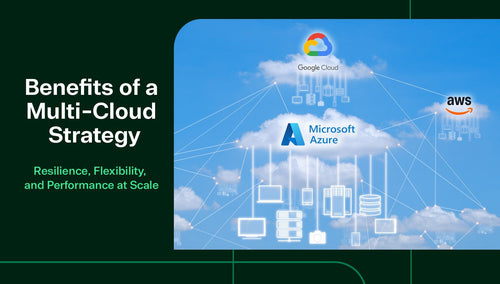
In the early days of cloud computing, the goal was simple: get out of the data center. Today, the conversation has shifted. It is no longer a matter of whether you use the cloud, but how many you use.
Multi-cloud, which is the deliberate practice of using cloud computing services from at least two different providers (such as AWS, Google Cloud, and Azure), has transitioned from a niche tactic to the default operating model for modern enterprise. According to market analysis, over 90% of large enterprises have adopted a multi-cloud architecture.
This shift isn't accidental. While managing multiple environments introduces complexity, the strategic advantages, which range from bulletproof resilience to unmatched bargaining power, far outweigh the operational overhead for growing organizations.
This guide explores why multi-cloud matters, how to implement it correctly, and the real-world benefits that are driving this massive industry shift.

Why Multi-Cloud Is Becoming the Default
At its core, a multi-cloud strategy is the use of two or more cloud computing services. Unlike a hybrid cloud, which typically blends on-premises private clouds with a public cloud, a multi-cloud approach focuses on distributing workloads across multiple public providers, such as Google Cloud Platform (GCP), Amazon Web Services (AWS), and Microsoft Azure.
Why the rush to diversify?
As organizations scale, they often realize that a "one-size-fits-all" cloud creates limitations. A single provider might be excellent for storage but expensive for machine learning. Another might offer great computing power but lack specific regional data centers required for compliance.
Who benefits most?
- Global Enterprises: Organizations that need low-latency access for users in every continent.
- Regulated Industries: Finance and healthcare sectors that require strict data sovereignty.
- High-Growth Tech: Companies needing the ability to spin up vast resources without hitting single-vendor capacity limits.

Core Benefits of a Multi-Cloud Strategy
Shifting to a multi-cloud architecture is a strategic investment. Here are the six primary drivers for adoption.
1. Avoiding Vendor Lock-In & Reducing Risk
The fear of "vendor lock-in" is perhaps the most frequently cited reason for adopting a multi-cloud strategy. When an organization relies 100% on a single provider, it is beholden to that vendor’s pricing models, service roadmaps, and uptime.
- Provider Independence: By architecting applications to run on multiple clouds (often using containers and Kubernetes), you retain the freedom to move workloads if a vendor changes their terms or raises prices.
- Bargaining Power: Major enterprises often use their multi-cloud status as leverage during contract renewals. If you can credibly demonstrate that you can move your data to a competitor, you are in a stronger position to negotiate discounts.
2. Boosting Resilience & Ensuring
High Availability Downtime is expensive. Even the biggest cloud providers experience outages due to technical errors or physical disasters.
A multi-cloud architecture acts as the ultimate insurance policy. If your primary cloud provider in the "US-East" region experiences a catastrophic failure, a multi-cloud disaster recovery (DR) strategy enables you to fail over to a secondary provider in minutes.
Note on Architecture: True resilience requires redundant architecture. This means maintaining backups and "warm" standby environments across different providers, ensuring that a single point of failure cannot take down your entire business.
3. Performance Optimization Through "Best-of-Breed" Services
Not all clouds are created equal. Different providers have different strengths:
- Google Cloud (GCP): Often cited for leadership in open source, AI, and data analytics.
- AWS: Known for an enormous breadth of services and serverless maturity.
- Azure: Preferred for seamless integration with enterprise Microsoft ecosystems.
By adopting a multi-cloud approach, engineering teams can "cherry-pick" services. You might host your front-end application on AWS to leverage their global CDN, while running your heavy data analytics workloads on GCP to utilize BigQuery. This enables you to optimize performance by matching the workload to the optimal environment.
4. Enhancing Compliance & Supporting Data Sovereignty
For global organizations, data gravity and sovereignty are massive challenges. Laws like GDPR in Europe or CCPA in California dictate strictly where user data can physically reside.
A single cloud provider may not have a data center in a specific jurisdiction where you do business. Multi-cloud solves this by allowing you to select providers based on their geographic footprint. You can store German customer data in a Frankfurt-based instance of one cloud, while keeping US data in Northern Virginia on another, ensuring you meet strict regulatory requirements without building your own physical data centers.
5. Cost Optimization Through Strategic Resource Allocation
While managing two clouds can be more expensive due to complexity, it can also drive significant savings if handled correctly.
- Arbitrage: You can take advantage of price differences for similar services (e.g., storage or compute instances) between providers.
- Spot Instances: You can bid on unused capacity across multiple clouds, drastically lowering compute costs for fault-tolerant workloads.
The Egress Fee Trap: One area to watch is egress fees, which are the costs associated with moving data out of a cloud. A smart multi-cloud strategy minimizes data movement between clouds to avoid these fees, instead processing data where it resides.
6. Agility & Scalability for Rapid Growth
Innovation requires speed. Multi-cloud environments provide high elasticity. If a sudden marketing campaign drives 10x traffic, and one provider is near capacity or throttling your instance limits, you can spill over traffic to a second provider. This ensures infrastructure limitations never bottleneck your growth.

Challenges You Could Encounter
Despite the benefits, multi-cloud is not a "magic bullet." It introduces significant operational friction that must be managed.
- Security Complexity: The "attack surface" increases significantly. You are no longer securing one perimeter; you are securing two or three, each with different IAM (Identity and Access Management) protocols.
- Skills Gap: Finding engineers who are experts in AWS is hard; finding engineers who are experts in AWS, Azure, and GCP is nearly impossible. Teams often face a steep learning curve.
- Fragmented Management: Without the right tools, you end up with "swivel chair" operations, where logging into multiple dashboards to monitor system health leads to governance blind spots.
Best Practices for Implementing a Multi-Cloud Strategy
To succeed, you must move beyond manual management and embrace automation and abstraction.
- Adopt a "Zero Trust" Security Model: Never trust a network perimeter. Use identity-based security that works across all clouds.
- Contain Everything: Use Docker and Kubernetes. Containers abstract away the underlying infrastructure, making applications portable between clouds.
- Use Cross-Cloud Management Tools: Invest in "single pane of glass" platforms (like Terraform for Infrastructure as Code) that allow you to provision and monitor resources across all providers from one interface.
- Automate Policy Enforcement: Use policy-as-code tools to ensure that if a developer spins up a server in Azure or AWS, it automatically adheres to the same security and compliance standards.
- Implement FinOps: Create a consistent cost governance strategy. Tag resources identically across clouds so you can track spending by project, not just by vendor.

Is Multi-Cloud Right for Every Organization?
When it makes sense:
- You are an enterprise with complex compliance needs.
- You spend over $1M/year on cloud and need negotiating leverage.
- Your uptime requirements are mission-critical (99.999%).
When it might be overkill:
- You are a small startup focused on speed-to-market.
- Your team lacks deep DevOps expertise.
- You simply want to "try" another cloud without a strategic reason.
A hybrid approach, such as a combination of cloud and on-premises solutions or a single-cloud focus, is sufficient for most small businesses until they reach a certain scale.
A Flexible Future with Multi-cloud Ecosystems
The future of cloud computing is undoubtedly distributed. As the landscape evolves, the "walled gardens" of individual providers are giving way to interoperable, flexible multi-cloud ecosystems.
While the journey involves overcoming complexity in security and management, the destination, that being an organization that is resilient, agile, and cost-efficient, is well worth the effort. By treating multi-cloud not just as a technology choice, but as a business strategy, leaders can future-proof their infrastructure against the uncertainties of the digital economy.

Multi-Cloud Strategy FAQ
Q. What exactly is a multi-cloud strategy?
A. A multi-cloud strategy is the deliberate use of cloud computing services from at least two different providers, such as AWS, Google Cloud, and Microsoft Azure. It focuses on distributing workloads across multiple public clouds to gain flexibility, resilience, and cost control.
Q. How does multi-cloud differ from hybrid cloud?
A. A multi-cloud strategy uses two or more public cloud providers to run workloads, while a hybrid cloud strategy combines on-premises or private cloud infrastructure with a public cloud. Multi-cloud is about diversifying across public providers, whereas hybrid cloud is about blending private and public environments.
Q. Which types of organizations gain the most from a multi-cloud strategy?
A. Multi-cloud is especially beneficial for global enterprises that require low-latency access worldwide, regulated industries such as finance and healthcare that must meet stringent data sovereignty requirements, and high-growth tech companies that need to scale quickly without hitting single-vendor limits.
Q. What are the main advantages of implementing a multi-cloud strategy?
A. The primary benefits of a multi-cloud strategy include avoiding vendor lock-in, enhancing bargaining power, improving resilience and availability, optimizing performance with best-of-breed services, increasing compliance and data sovereignty, facilitating cost optimization, and providing the agility and scalability necessary for rapid growth.
Q. How does multi-cloud help prevent vendor lock-in and lower risk?
A. By architecting applications to run on multiple clouds, often using containers and Kubernetes, organizations retain the ability to move workloads between providers if pricing, terms, or service quality change. This independence reduces reliance on a single vendor and strengthens negotiating leverage during contract renewals.
Q. How does a multi-cloud strategy enhance resilience and availability?
A. A multi-cloud architecture enables organizations to fail over to an alternative provider if their primary cloud experiences an outage or regional disruption. By maintaining redundant backups and warm standby environments across different providers, multi-cloud eliminates single points of failure and helps ensure high uptime.
Q. How can multi-cloud enhance performance and optimize workloads?
A. Multi-cloud enables teams to select the best services from each provider. For example, they might use AWS for global content delivery, Google Cloud for advanced analytics with BigQuery, and Azure for tight integration with Microsoft tools. Matching each workload to the cloud where it runs best helps maximize performance.
Q. How does multi-cloud support compliance and data sovereignty requirements?
A. Multi-cloud enables organizations to store data in regions that align with local regulations, such as GDPR or CCPA. They can store customer data in specific jurisdictions, such as hosting German data in the Frankfurt region and U.S. data in a U.S. region, without needing to build their own data centers.
Q. Can multi-cloud strategies help reduce costs?
A. Yes, when managed well, multi-cloud can lower costs by leveraging price differences between providers and utilizing discounted or spot instances for suitable workloads. However, organizations must manage complexity carefully and minimize unnecessary data transfers between clouds to avoid high egress fees.
Q. What challenges are involved in implementing a multi-cloud strategy?
A. Multi-cloud adds complexity in security, skills, and management. Organizations must secure multiple environments with different IAM models, find or train staff with expertise across several platforms, and avoid fragmented monitoring and governance caused by juggling multiple dashboards and tools.
Q. What are the best practices for successfully implementing a multi-cloud strategy?
A. Best practices include adopting a Zero Trust security model, utilizing containers and Kubernetes to make applications portable, investing in cross-cloud management tools and infrastructure-as-code solutions like Terraform, enforcing security and compliance through policy-as-code, and implementing FinOps practices with consistent tagging to manage costs across providers.
Q. Is multi-cloud suitable for every organization?
A. Multi-cloud is a strong fit for enterprises with complex compliance requirements, significant cloud spending, and mission-critical uptime needs. It may be overkill for small startups that prioritize speed-to-market, lack deep DevOps expertise, or can meet their needs with a single cloud or simple hybrid approach until they scale.