
For many years, phishing has been treated as a basic cybersecurity issue. It was annoying, obvious, and usually easy to spot. A strange sender, poor grammar, or a suspicious link gave it away. Users were told to “think before you click,” and organizations relied on email filters to catch most threats.
That world no longer exists.
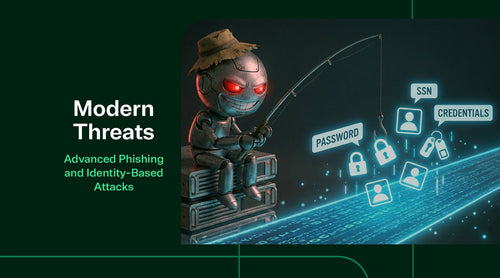
In 2025, phishing is the number one initial access vector for cyber intrusions. It has evolved into a sophisticated, multi-stage attack strategy that targets human trust and digital identity rather than systems and networks. Powered by artificial intelligence and delivered across multiple channels, modern phishing campaigns are designed to steal credentials, session tokens, and access rights that enable attackers to move undetected within organizations.
This shift has changed everything. Identity is now the real perimeter, and phishing is the fastest way through it.
Modern Phishing: Why One Click Can Be Catastrophic
In this episode of The Microsoft Playbook, we delve into the latest and most creative phishing threats.
Joined by Andy Nolan, Director of Strategic Programs at TrustedTech, we unpack real-world phishing scenarios that go far beyond the classic “reset your password” email. From deceptive look-alike domains like rncrosoft.com, to malicious PDFs to physical attacks involving infected USB drives, this conversation highlights how a single click or plug-in can lead to catastrophic security breaches.
You’ll hear firsthand stories from Andy’s 15+ years in IT and security, including:
- How a simple phishing email led to a massive data exposure in the adult entertainment industry
- How nation-state attacks leveraged human curiosity with physical media
- Why Microsoft Defender’s layered protections are critical in stopping these threats before they escalate
We also cover how Microsoft Defender works behind the scenes, including URL detonation, sandboxing, domain reputation checks, USB controls, and anomaly detection—and how TrustedTech’s Cloud Security Envisioning Workshop helps organizations identify gaps and strengthen their security posture before attackers do.

Phishing Has Advanced Beyond the Inbox
Phishing still often begins with email, but it rarely ends there. Today’s attackers understand that organizations have invested heavily in email security, so they adapt. If an email fails, they try a text message. If that fails, they make a phone call or send a message through a collaboration tool. The attack continues until someone responds.
This persistence works because phishing is no longer just about tricking users into clicking links. It involves building trust over time, often through multiple interactions and channels, to establish legitimacy.
At the same time, attackers have shifted their focus. Instead of trying to break into networks directly, they target people and the digital identities that represent them. Credentials, session cookies, OAuth tokens, and cloud access keys are now the most valuable assets in an environment where applications live in the cloud and employees work from anywhere.
How AI Changed Phishing Forever
Artificial intelligence has significantly reduced many of the barriers that previously limited phishing attacks. In the past, successful phishing required proficiency in language skills, cultural awareness, and considerable time and effort. Today, AI does all of that instantly.
Attackers use AI to generate polished, context-aware messages that appear to have been written by real coworkers. These messages reference job roles, internal tools, recent projects, and even current events. What used to be targeted “spear-phishing” is now mass-produced at scale, with every message feeling personal.
The impact goes far beyond email. AI-powered chatbots can engage victims in real-time conversations, responding naturally to questions and adjusting their approach if the target hesitates. Voice cloning tools can replicate an executive’s voice with startling accuracy. Video deepfakes can place realistic faces into virtual meetings.
There have already been real incidents where employees joined video calls that appeared to include their CEO and CFO, only to later discover that every participant was an AI-generated fake. In those cases, the attackers successfully convinced victims to authorize large financial transfers.
The uncomfortable truth is that seeing and hearing someone is no longer proof of identity. For still images used in suspicious profiles, messages, or identity-verification requests, an AI image checker can provide an additional layer of scrutiny by identifying signs that visual content may have been artificially generated or manipulated.
Traditional detection methods struggle in this environment. AI-generated phishing messages often lack obvious red flags. They are grammatically correct, relevant, and emotionally persuasive. Filters that rely on known patterns or signatures often fail to detect them, and users have little reason to be suspicious.

Identity Becomes the Primary Target
As organizations improved network security, attackers adapted by focusing on identity. If an attacker can successfully impersonate a valid user, most systems will automatically trust them.
Password theft still happens, but modern attacks go further. Instead of stopping at credentials, attackers steal session tokens and authentication cookies. These artifacts allow them to reuse an already authenticated session, bypassing multi-factor authentication entirely. This technique, known as session hijacking or token replay, is now common in major breaches.
Single Sign-On and OAuth, while convenient, also expand the attack surface. A single compromised token can unlock multiple cloud services. OAuth consent phishing is especially dangerous because it does not require a password at all. Victims are tricked into approving a malicious application, which then gains persistent access to email, files, or calendars through legitimate APIs.
Attackers also target non-human identities such as service accounts, API keys, and automation credentials. These accounts often have broad privileges and minimal oversight. In cloud environments filled with thousands of identities, one exposed key can lead to widespread compromise.
One of the most effective techniques in use today is adversary-in-the-middle phishing. These attacks use proxy-based phishing sites that relay traffic between the victim and the real login page. The user sees a legitimate site, completes MFA successfully, and never realizes that their credentials and session tokens were intercepted in real time.
Because these tools are now sold as a service, even low-skilled attackers can defeat strong authentication controls.
Phishing Is Now Multi-Channel by Design
Modern phishing campaigns rarely rely on a single message. Instead, they combine email, phone calls, text messages, and chat platforms into coordinated social engineering efforts.
Voice phishing, also known as vishing, is particularly effective. Attackers often pose as IT support personnel, vendors, or executives and create a sense of urgency. Some campaigns avoid links entirely, instructing victims to call a phone number. This approach bypasses email scanning tools and shifts the attack to a channel where many organizations have fewer controls.
Text message phishing, also known as smishing, continues to grow. People tend to trust SMS more than email, especially on mobile devices where URLs are harder to inspect. Many mobile malware campaigns have spread this way, disguised as delivery notifications or account alerts.
Collaboration platforms have also become targets. Attackers send messages through Teams, Slack, LinkedIn, and WhatsApp, often impersonating internal staff or recruiters. Because these platforms feel more personal and informal, users are more likely to engage.
Business Email Compromise has evolved into what many now call “BEC 3.0.” Instead of obvious fake emails, attackers abuse legitimate services like Dropbox, Google Docs, or PayPal. Victims receive real notification emails from trusted platforms, but the fraud hides in shared files, comments, or follow-up instructions.
The common thread across all of these attacks is trust. Attackers use real services, familiar tools, and believable personas to lower suspicion.
Evasion Techniques That Defeat Traditional Defenses
As detection improves, attackers find new ways to conceal their activities. One popular technique is HTML smuggling, where a harmless-looking HTML file reconstructs malicious code directly in the victim’s browser. Security teams often use an HTML Viewer online to inspect suspicious HTML files safely before opening them. Because the malware is built locally, it never passes through email gateways or network scanners.
Attackers also use polymorphic links, which change their behavior over time. A link may appear safe during scanning, but it may redirect to a phishing site hours later. Some campaigns generate unique links for each victim, making blocklists ineffective.
Multi-step infection chains are also common. An email leads to a PDF, which contains a QR code, ultimately directing the user to a phishing site. By the time defenders investigate, the content may be gone.
To avoid automated scanning, phishing pages often include CAPTCHAs and legitimate security features. These block bots, while reassuring users that the site is “secure.”
Attackers are increasingly hosting malicious content on trusted cloud platforms, such as SharePoint, OneDrive, and Google Drive. Traffic from these services blends in with normal business activity, making it harder to detect.

Phishing as the Gateway to Ransomware
Phishing is no longer just a data theft problem. It is now the primary means of delivery for ransomware.
Many ransomware attacks begin with a single phishing email or social engineering interaction. Once attackers gain initial access, they steal credentials, escalate privileges, and move laterally through the environment. Over the course of days or weeks, they disable defenses, locate backups, and prepare the network for maximum impact.
When ransomware is finally deployed, the damage is severe. Operations stop, data is encrypted, and recovery becomes expensive and slow.
Ransomware groups prefer phishing because it is a quiet and reliable method. Compromised identities enable attackers to blend in and evade detection, thereby avoiding alerts. By the time encryption begins, the attackers often already control critical systems.
Stopping phishing early can stop ransomware entirely. Failing to do so can lead to catastrophic outcomes.
What Advanced Phishing Defense Now Looks Like
Defending against modern phishing requires a shift in mindset. Prevention alone is not enough. Organizations must assume compromise and focus on limiting impact.
An identity-first, Zero Trust approach is essential. Every access request should be verified continuously, not just at login. Privileges should be limited, and lateral movement should be restricted.
Strong authentication matters, but not all MFA is equal. SMS codes and push notifications can be intercepted or abused. Phishing-resistant methods, such as FIDO2 security keys and passkeys, provide significantly stronger protection because they cannot be replayed on fake websites.
Behavioral monitoring plays a critical role. Even if an attacker steals valid credentials, their behavior often differs significantly from that of the real user. Unusual login locations, abnormal data access, and unexpected application usage are all signals that something is wrong.
Security must also extend beyond email. Employees need training that reflects modern threats, including deepfakes, voice scams, and multi-channel attacks. They should be encouraged to slow down, verify unusual requests, and report anything suspicious, regardless of the medium.
Cloud identity controls should also be tightened. OAuth permissions should require oversight, token lifetimes should be limited, and service accounts should be monitored closely.

The Future of Phishing
Phishing and identity-based attacks will continue to evolve. AI will enable faster, more personalized, and harder-to-detect attacks. Communication channels will continue to blur, and attackers will exploit whatever platforms people trust most.
Defenders will also increasingly rely on AI, using it to detect anomalies, validate identities, and assist analysts. But technology alone will not solve the problem.
Organizations that succeed will be those that treat identity as the foundation of security. Protecting credentials, tokens, and access flows will matter more than any single tool.
Phishing may never disappear, but its impact can be reduced. By focusing on identity, behavior, and resilience, organizations can stay ahead in a threat landscape where trust itself has become the target.

Whitepaper Research Report
Shadow AI in the Workplace
Shadow AI, employees using AI tools their employer hasn’t approved, has gone from a niche IT concern to mainstream workplace behavior in under two years.
- Who is using Shadow AI, and why
- The 35-point confidence gap separating leaders from their teams
- Why one in three employees would keep using AI even if it meant disciplinary action