
Last updated: July 24, 2026
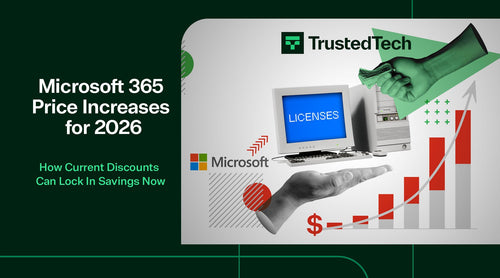
Microsoft’s 2026 price increase went live on July 1, 2026, raising list prices across most commercial Microsoft 365 and Office 365 suites, standalone products like Entra ID and Windows, and Government Community Cloud offerings. Existing customers move to the new rate at their next renewal after that date. For Enterprise Agreement customers specifically, the list increase lands on top of a separate change, Microsoft’s removal of EA volume discounts, so the real number on a renewal quote is often well above the published percentage. This guide gives the new price for every commercial plan, explains why enterprise renewals run higher than the headline, and lays out the levers that actually reduce your bill.
The plans still holding flat are Microsoft 365 Business Premium and Office 365 E1. Everything else is going up, with the steepest percentage jumps on the frontline plans. Every figure below is confirmed against Microsoft’s official pricing and packaging update and cross-checked against Microsoft’s December 2025 announcement.
Microsoft 365 2026 prices, by plan (with Teams)
Commercial list prices in USD, per user per month, for the suites that include Microsoft Teams. Pricing varies by region, currency, and agreement; CSP and volume pricing may differ.
| Plan | Old price | New price (2026) | Change |
|---|---|---|---|
| Microsoft 365 Business Basic | $6.00 | $7.00 | +16% |
| Microsoft 365 Business Standard | $12.50 | $14.00 | +12% |
| Microsoft 365 Business Premium | $22.00 | $22.00 | No change |
| Office 365 E1 | $10.00 | $10.00 | No change |
| Office 365 E3 | $23.00 | $26.00 | +13% |
| Office 365 E5 | $38.00 | $41.00 | +8% |
| Microsoft 365 E3 | $36.00 | $39.00 | +8% |
| Microsoft 365 E5 | $57.00 | $60.00 | +5% |
| Microsoft 365 F1 (frontline) | $2.25 | $3.00 | +33% |
| Microsoft 365 F3 (frontline) | $8.00 | $10.00 | +25% |
Microsoft 365 E7, which bundles E5, Microsoft 365 Copilot, Microsoft Entra Suite, and Agent 365 into a single $99-per-user SKU, is not part of this price change. It’s worth noting anyway: the packaging updates landing on E5 (Security Copilot capacity, expanded Intune) also apply to E7, so an E7 renewal picks up the same feature additions without a list-price move.
No-Teams prices: where the biggest jumps are
Microsoft sells versions of these suites without Teams at lower prices, a split that started with EU competition rulings and now applies globally. The percentages here are higher than those for the Teams versions, and Microsoft 365 F1 without Teams shows the single largest increase across the entire update at 43 percent. If your organization standardized on a different meeting platform, these SKUs can still come in under the with-Teams prices, but the jump is steeper.
| Plan (no Teams) | Old price | New price | Change |
|---|---|---|---|
| Office 365 E3 (no Teams) | $14.45 | $17.45 | +14% |
| Office 365 E5 (no Teams) | $29.45 | $32.45 | +10% |
| Microsoft 365 E3 (no Teams) | $27.45 | $30.45 | +11% |
| Microsoft 365 E5 (no Teams) | $48.45 | $51.45 | +6% |
| Business Basic (no Teams) | $4.40 | $5.40 | +23% |
| Business Standard (no Teams) | $9.29 | $10.79 | +16% |
| Microsoft 365 F1 (no Teams) | $1.75 | $2.50 | +43% |
| Microsoft 365 F3 (no Teams) | $6.93 | $8.93 | +29% |
Standalone products and Government pricing also moved
The commercial suites get most of the attention, but the update reaches further:
Standalone products
Entra ID, Enterprise Mobility + Security (EMS), Windows E3/E5, and Microsoft 365 Apps all carry list-price increases as part of this update, generally in line with the percentage moves on the suites that bundle them. If your organization buys any of these as standalone SKUs rather than inside a Microsoft 365 suite, check the standalone pricing table on Microsoft’s official update page rather than assuming the suite percentage applies directly, since standalone and bundled pricing don’t always move in lockstep. Standalone Microsoft Teams and standalone Microsoft 365 Copilot licenses are the notable exclusions: neither is affected by this update.
Government pricing
GCC and GCC High suites see increases in roughly the same range as their commercial equivalents, generally around 8 percent for the plans most agencies use, also effective July 1, 2026. Increases above 10 percent are phased in over multiple years for government customers rather than landing all at once, a distinction commercial customers don’t get. US Federal, State, and Local Government agencies on AOS-G (Agreement for Online Services – Government) are unaffected by the EA discount change described below, which makes AOS-G comparatively more attractive than a standard EA for agencies weighing their options at renewal.
Monthly billing
Separately from this update, Microsoft’s April 2026 change adding a 5 percent premium to annual subscriptions billed monthly remains in effect. It stacks with whatever plan-level increase applies, so a monthly-billed annual E3 seat sees the E3 increase plus this premium, not just the E3 increase alone.

Microsoft 365 Cost Optimization
How to Reduce Microsoft 365 Costs by 20% or More
The Complete Playbook for Reducing M365 Spend. Everything IT leaders and procurement teams need to cut Microsoft 365 costs without cutting capability.
- License right-sizing strategies
- SKU comparison and downgrades
- CSP vs. direct pricing analysis
- Governance and audit frameworks
- Copilot and add-on cost controls
- Renewal negotiation tactics
Why the increase is bigger than the headline for many enterprises
The published percentages are only part of the story on an Enterprise Agreement. Effective November 1, 2025, Microsoft eliminated the programmatic Levels B, C, and D volume discounts for online services across EA, EA Subscription, and MPSA agreements, a separate change from the July price update. Before that date, larger organizations on Level D pricing (roughly 15,000-plus seats) received automatic discounts in the range of 12 percent off list; Level C and B customers received smaller but still meaningful reductions. After November 1, 2025, every organization defaults to Level A, which is to say Microsoft.com list price, regardless of size, at their next renewal or when adding any online service not already on their price sheet. On-premises licensing and US Government and Education price lists are excluded from this change.
That discount removal stacks directly on top of the July list increase, so an enterprise renewing an EA now faces two cost events at once rather than one. In practice, what we typically see when modeling EA renewals for clients moving from a Level C or D agreement is that the combined effect lands closer to 15 to 20 percent above the prior year’s effective rate, even though the E3 or E5 list increase alone is only 5 to 8 percent. For a representative 25,000-seat organization on Microsoft 365 E5 that held Level D pricing, that combined shift can approach seven figures in additional annual spend. Treat the list-price delta in the tables above as a floor, not the full number, and confirm your organization’s own effective rate against your Customer Price Sheet before you accept a renewal quote.
The lost discount is also prompting many enterprises to question whether an Enterprise Agreement is still the right purchasing vehicle. The Cloud Solution Provider (CSP) model can restore per-seat flexibility and remove the true-up mechanics that make an EA expensive to carry, which is why we cover the pros and cons of switching from EA to CSP in detail, along with the common questions organizations ask before making that move. It doesn’t suit every organization, but a price increase paired with the removal of a discount is exactly the moment to run that comparison.
There is a second enterprise cost to model on E5. Microsoft Security Copilot is now included, but only up to a set capacity: 400 Security Compute Units per month for every 1,000 paid E5 licenses, capped at 10,000. Beyond that, usage is billed pay-as-you-go (confirm the current per-unit rate with Microsoft, as published figures have varied). Heavy investigation, automation, or promptbook use can burn through the included capacity faster than expected, so build a usage assumption into the renewal rather than treating Security Copilot as free-forever. This capacity model also feeds into your broader Microsoft spend picture: since Microsoft Unified Support pricing scales with overall Microsoft spend, a higher licensing baseline plus metered Security Copilot usage can push Unified Support costs up in parallel, which is worth modeling alongside the license line rather than in isolation.
What the higher price includes
This is a value-and-price update, not a price-only one. E3 gains Microsoft Defender for Office 365 Plan 1 and several Intune tools; E5 adds Security Copilot capacity and advanced Intune management; Business plans get enhanced Copilot Chat and 50 GB more mailbox storage. For the full plan-by-plan breakdown of what each license now includes and when it rolls out, see our companion guide to the Microsoft 365 2026 new features by plan. The reason it matters for cost: if a newly bundled capability replaces something you buy separately, dropping the duplicate is one of the cleanest ways to offset the increase.
How to lower your cost at renewal
The lock-in-before-July-1 window has closed, but the levers that reduce a renewal are evergreen, and they matter more now that the baseline is higher. None of them requires a promotion.
Right-size before you renew
Most tenants hold licenses for people who left, changed roles, or never used the apps their licenses cover. Pull a sign-in and usage report from the Microsoft 365 admin center for the last 90 days and retire or reassign anything below meaningful use. Every seat you remove is now repriced upward, so cleanup pays back more than it did a year ago. Our guide to reducing Microsoft 365 costs through licensing optimization walks through the process. On an EA specifically, unused capacity is what the shelfware-versus-elasticity case for moving to CSP is built on.
Drop add-ons that are now bundled
If you pay separately for Microsoft Defender for Office 365 Plan 1 on top of E3, that capability moves into the base plan by August 1, 2026, and the standalone add-on becomes a candidate for cancellation at renewal. Map every add-on you carry to the new bundled features and remove duplicates. The catch is timing: if you’re mid-term on a third-party email security contract, you can’t capture the savings until that contract lapses, so line up the two renewal dates.
Model your plan mix and term
The gap between Business Standard ($14) and Business Premium ($22) has narrowed to $8, making Premium worth remodeling for any organization with real device management or security needs. On the enterprise side, weigh E3-plus-add-ons against E5 now that both have shifted, and factor in whether E7 makes more sense than assembling the equivalent stack piece by piece. Term length and renewal timing also affect your rate: monthly billing on an annual term now carries a 5 percent premium on top of whatever plan-level increase applies, so model a multi-year annual-prepaid commitment against month-to-month before you sign.
Microsoft promotions do exist and change frequently, and eligibility is usually limited to new-to-offer or new-to-suite customers on multi-year terms. Because those offers move month to month, we don’t list them here; a quick licensing review with TrustedTech will surface any promotion you actually qualify for at your renewal.
Find Hidden Waste in Your Microsoft 365 Stack
What kind of M365 admin are you? Uncover ways to reduce costs, simplify management, and improve security.

Savings scenarios: what the increase looks like in dollars
Representative examples at the new list prices, to size the impact and the payback from right-sizing. Your real numbers depend on seat counts, agreement, and eligibility.
Mid-market: 500 users on Microsoft 365 E3
At the new $39 rate, 500 seats run about $234,000 a year, roughly $18,000 more than at the old $36. Trimming even 5 percent of unused seats before renewal (25 licenses) claws back about $11,700 a year, more than half the increase.
Enterprise: 1,000 users on Microsoft 365 E5
At $60, 1,000 seats cost about $720,000 a year, roughly $36,000 above the old $57 on list alone. If your EA also lost Level B, C, or D discounts at November 2025 renewal, the effective jump can be materially larger, which is why the enterprise number is worth modeling fully rather than reading off the price sheet.
Large enterprise: 25,000 users on Microsoft 365 E5, EA renewal
This is the scale where the discount removal dominates the math. A 25,000-seat organization that previously held Level D pricing was paying roughly $50 per user per month effectively; at the new $60 list price with no volume discount to fall back on, that’s closer to a 20 percent effective increase, not the 5 percent the price sheet shows. On an $18 million annual estate, that’s in the range of $3 million more per year, split between the list increase and the lost discount. This figure is representative, built from the publicly disclosed Level D discount range and the new list price, not a specific client’s contract; your organization’s actual prior discount level will move the number up or down.
Frontline: 5,000 users on Microsoft 365 F1
At the new $3 with-Teams rate, 5,000 frontline seats add about $45,000 a year over the old $2.25. Choosing the without-Teams SKU only makes sense if those workers genuinely don’t use Teams, because that version carries a 43 percent increase of its own.
Microsoft 365 price increase: FAQ
Q: How much are Microsoft 365 prices going up in 2026?
A: Increases run from 5 percent (Microsoft 365 E5) to 33 percent (Microsoft 365 F1 with Teams), and up to 43 percent for F1 without Teams. Microsoft 365 E3 goes from $36 to $39, E5 from $57 to $60, Business Basic from $6 to $7, and Business Standard from $12.50 to $14. Business Premium ($22) and Office 365 E1 ($10) are unchanged. Standalone products (Entra ID, EMS, Windows E3/E5, Microsoft 365 Apps) and Government Community Cloud suites also see increases, generally in line with their commercial equivalents.
Q: When does the price increase apply to my organization?
A: New pricing took effect July 1, 2026 for new purchases. Existing customers move to the new prices at their next renewal after that date, so a mid-term agreement keeps its current rate until it renews.
Q: Why is my enterprise increase higher than the published percentage?
A: For Enterprise Agreement customers, the list increase stacks on top of the EA volume discounts (Levels B, C, and D) that Microsoft eliminated on November 1, 2025. Every EA and MPSA customer now defaults to Level A list pricing at renewal. For organizations that previously held a Level C or D discount, the combined effective increase can approach 15 to 20 percent, well above the 5 to 8 percent shown on the price sheet.
Q: Is Security Copilot really included in E5, or is there a catch?
A: It’s included up to a capacity of 400 Security Compute Units per month per 1,000 paid E5 licenses, capped at 10,000. Usage beyond that is billed pay-as-you-go, so heavy Security Copilot use can create an additional metered cost. Confirm the current overage rate with Microsoft.
Q: Do Government and GCC customers see the same increases?
A: Roughly, yes. GCC and GCC High suites see increases around 8 percent for most plans, effective the same July 1, 2026 date, but increases above 10 percent are phased in over multiple years for government customers rather than applying immediately. US Federal, State, and Local Government agencies on AOS-G are excluded from the separate EA discount removal.
Q: What’s the best way to reduce the cost now that the increase is live?
A: Right-size unused and duplicate licenses before renewal, cancel add-ons that are now bundled into your plan (such as Defender for Office 365 Plan 1 on E3), and model your plan mix, term length, and billing frequency, since monthly billing on an annual term carries its own 5 percent premium. A licensing review can also identify any current Microsoft promotion you qualify for.
Q: Should we move from an Enterprise Agreement to CSP because of the increase?
A: For some organizations, yes. With EA volume discounts gone, the CSP model can offer more flexible per-seat purchasing and easier right-sizing, though the right answer depends on your size, term length, and how you buy Azure. Our EA to CSP FAQ covers the common questions.
Q: Do the increases apply to standalone Teams or Copilot?
A: No. Standalone Microsoft Teams and standalone Microsoft 365 Copilot licenses are excluded from this pricing and packaging update.
The bottom line: model it before you renew
The increase is here, so the win is no longer in beating a deadline; it’s in walking into your renewal with clean license data, the add-ons you no longer need cancelled, and a plan mix that matches how your team actually works. For enterprises, the EA discount change means the real number is bigger than the price sheet suggests, which makes modeling before the conversation more valuable than ever, and that modeling now needs to account for standalone products, billing frequency, and Government-specific timing alongside the headline suite prices.
Want the fully loaded number for your tenant and a plan to bring it down? Request a Microsoft 365 licensing review and we’ll model your renewal against your actual seat count and usage.